These are all the identities and definitions that you need to know for trigonometry questions on ACT Math. For more ACT trigonometry, check out the law of sines and law of cosines.
Want a Free List of All the Math Topics That Have Recently Appeared on the SAT or ACT?
For a free list of all the math topics that have recently appeared on the SAT or ACT, and/or for answers to any other questions, you can reach me at robertkohen@koheneducationalservices.dream.press or 212-658-0834.
If you’re an international student, you may have heard of the SAT, the entrance exam required by the vast majority of American colleges. If you’re thinking of attending college in the United States, however, you’re also eligible to submit the ACT exam instead.
Logistically speaking, registering for the SAT might be a bit easier than the ACT. The SAT boasts over 1,000 international testing centers, whereas the ACT has only around 400. If you live a minimum of 75 miles away from a testing center, however, you can usually work with the SAT or ACT directly to schedule a more convenient test administration.
While you won’t know which test you prefer until you’ve taken an official, timed practice test for each, many international students prefer the ACT. This is especially true for students whose first language is not English. The reason for this is twofold.
First, the ACT does not test your grasp of the English language as rigorously as does the SAT. Most notably, the SAT tests vocabulary whereas the ACT does not. SAT vocabulary can be very advanced and shows up all throughout the exam, from passages to questions to answer choices.
Not only does the ACT not test vocabulary (although it has a few questions about word choice), but the overall difficulty level of English on the exam is lower than that on the SAT. Passages are often easier to understand, and the questions that ask about them tend to be more straightforward. For the SAT, on the other hand, you’ll need to have a more nuanced understanding of subtleties in the passages, which requires a more advanced grasp of the English language.
The second reason international students tend to prefer the ACT is that the exam is weighted more toward the quantitative than the verbal. International students tend to score better (and to improve more quickly) on quantitative testing than do American students, as the quality of math education overseas is often superior to that found in the United States. The ACT has two quantitative sections (Math and Science) and two verbal sections (English and Reading), whereas the SAT has only one quantitative section (Math) and two verbal sections (Reading and Writing). This also means that your command of English will be tested less on the ACT.
While you should take these considerations into account when choosing between the SAT and ACT, always make sure to take an official practice test for each to see which test is best for you.
If you’re feeling overwhelmed by ACT English, you can take comfort in the fact that it is a very repetitive and learnable section. It’s broken down into two main types of questions: grammar questions and rhetoric questions. Grammar questions tests the rules of English, while rhetoric questions ask about passage organization and topic.
Because the ACT tests the same grammar rules over and over, by learning these rules before test day you can drastically improve your score. You can find these rules (like this one) here on The SAT/ACT Blog and elsewhere.
Flash cards are a great way to help solidify the grammar you learn. If you use flash cards, make a card for each new rule. Come up with your own example for the rule to include on the card. This will help you to better understand and remember that rule. Then review these cards over time to ensure you don’t forget anything.
As you study ACT grammar, you should also take official, timed practice tests to chart your improvement. Mark your mistakes and make sure to review them frequently. One benefit to taking multiple practice tests is that you’ll begin to recognize the common patterns and trap answers on the English section, which I also discuss here on The SAT/ACT Blog. Being familiar with these will make it much easier to identify correct (and incorrect) answers.
To do well on grammar questions it’s also critical that you read for meaning. Many questions test which grammatical form would best reflect small nuances in meaning, so it’s essential that you pay attention to what each sentence, paragraph and passage is saying.
Reading for both grammar and meaning at the same time can be difficult. If you find that you’re having trouble doing both, one helpful strategy is to read a passage in its entirety before tackling the questions. Consider writing down the main point of the passage in a brief sentence or two. Then read through the passage a second time, answering the questions as you go. This can help you get a firmer understanding of the passage while affording you more mental bandwidth to tackle the grammatical issues on your second reading.
Whatever you do, make sure that whenever you do tackle the questions you’re always reading the passage alongside them. Don’t just read the underlined portion of the passage that the question is asking about, because he correct answer often depends on context. This is especially true for the second major type of questions on ACT English: rhetoric questions.
Rhetoric questions test passage organization and topic instead of grammar. You can often identify these questions by the big square box that encloses the question number. Anytime you see one of these boxes coming up, circle it. Pay extra attention to the meaning of what you’re reading as the box nears, since the question will in some way address the meaning or organization of what you’re reading.
The three major types of rhetoric questions deal with inserting or deleting sentences, sentence or paragraph order, and a passage’s main purpose or topic.
For questions that ask if you should insert or delete a sentence, pay extra close attention to the question itself. Underline any key words in the question. Often the question will ask what sentence would best accomplish something in particular. Let the details of the question guide you to the correct answer: make sure that the answer you choose accomplishes exactly what the question is asking it to do.
If the question simply asks whether or not a sentence should be added or deleted from the passage, ask yourself if that sentence contributes to the topic at hand in that particular paragraph. If a sentence is off-topic, it should not be included in the paragraph. Many of these questions present two “yes it should be included because…” and two “no it should not be included because…” answer choices. Before considering the choices, first decide if the sentence should be included. If it should be included, cross out the two “no” answers, and if not vice-versa. Then consider the reason. Try to put the reason in your own words before looking at the reasons given in the answer choices. This will help you avoid falling for a trap answer.
Some questions will ask which sentence is best to use at a particular point in the passage. The correct answer should form a logical and smooth transition between the sentence that comes before it and the sentence that follows it, so make sure to read around where the sentence will be inserted.
Other questions ask what would be primarily lost if a sentence were removed. Reread the sentence in the context of the paragraph as a whole. What does this sentence add to the paragraph that none of the other sentences add? This will be the correct answer.
The second major type of rhetoric question concerns sentence or paragraph order. A sentence or paragraph will often be presented out-of-order, and it will be up to you to determine where in the passage it should go. Again, ask yourself what that sentence or paragraph adds to the passage that no other sentence or paragraph adds. Then look back at the surrounding sentences or paragraphs to see where it would make the most logical sense to introduce this information. You want to introduce general information before other sentences or paragraphs that discuss it in detail, but you want detailed information to follow other sentences or paragraphs that introduce it in a general way.
The final major type of rhetoric question asks about the main point or topic of the passage. These questions always come at the very end of the passage. Try to put the writer’s main idea or topic in your own words. Then look at the question, which is usually worded “suppose the writer’s goal had been x…did she accomplish it?” If the goal matches the writer’s main point, only consider the yes answers, and if not only consider the no answers. Once again, try to put the entire answer in your own words before looking at the choices. How did the author succeed in addressing this topic, or why did the author fail to do so?
To determine the main point or topic of the passage, ask yourself what every paragraph in the passage is in the service of saying. All paragraphs should be unified by one central idea or message. This central idea is usually stated explicitly in the first and last paragraph of the essay. Pay special attention to the final sentences of the last paragraph. Another helpful place to look for the main idea or topic is the essay’s title. If the essay is called “Why Hockey Is The Greatest Sport Ever,” that’s a pretty strong tip-off that the essay is going to be primarily about why hockey is the greatest sport ever. Learning to read for the main idea can also help you on the reading section of the exam.
Now that you’re armed with these strategies, tackle some practice English sections to get comfortable using them. As long as you make sure to learn from your mistakes and review them, your grasp of the English section should improve with practice.
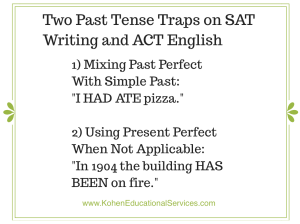
The SAT and ACT feature two traps designed to test your knowledge of past tense verbs. You’re likely to see both of these on test day.
The first concerns the two most basic past tenses: the simple past and the past perfect.
The simple past is formed from only one word and is used for an action that happened only in the past. Here are some examples:
I was hungry. I ate the pizza. We went to the movie.
The past perfect is used to indicate that a past action occurred before some other past action. It is formed by combining “had” with the past participle of the verb. Here are some examples:
I ate the pizza because I had been hungry. We took a nap because we had done a lot that day.
In the first example, the subject was hungry before he ate the pizza. In the second example, the subjects did a lot before they took a nap. You could also use the simple past in both of these examples, but the past perfect makes the temporal relationship between the verbs more clear.
To trick you, the SAT and ACT will incorrectly combine the simple past and past perfect into one tense. Here’s how they do it:
“Had” + “simple past form” [INCORRECT]
“I had ate” [INCORRECT]
In this example, the sentence needs to be changed to “I had eaten,” which correctly pairs the past participle (eaten), not the simple past (ate), with “had.”
Anytime you see the auxiliary verb “had” combined with another verb, make sure that the verb is in the past perfect form rather than the simple past. For some verbs these forms are identical (I looked at the book – I had looked at the book), but for others they’re different (I wrote a book – I had written a book).
The second common past tense trap concerns the present perfect tense. The present perfect is used to describe something that began in the past and continues into the present. It’s formed by combining “has/have” with the past participle of the verb. Here are some examples:
Mary has been wealthy a long time. We have run the race every year.
In the first example, Mary became wealthy sometime in the past and continues to be wealthy into the present. In the second example, the subjects started running the race sometime in the past and have continued to do so up to the present year.
The SAT and ACT love to incorrectly use the present perfect for an action that only occurred in the past and cannot continue into the present. Here’s what this looks like:
In 1904 the building has been on fire. [INCORRECT]
The present perfect is incorrect here because the sentence indicates that the action occurred in 1904, not from 1904 up to the present. If that’s what we wanted to convey, we could write:
Since 1904 the building has been on fire. [CORRECT]
Anytime you see a verb in present perfect form on the SAT or ACT, make sure that the sentence truly describes an action that began in the past and is continuing into the present.
Always be on the lookout for both of these traps when you take the test. An easy way to do this is to watch for had and has/have. If a sentence features a verb with had, make sure it takes the past participle rather than the simple past. If a sentence features a verb with has/have, make sure it makes sense to say that the action began in the past and is continuing into the present.
Anytime you register for the SAT you automatically receive four free score reports. This means that the College Board will send your scores to any four universities you choose, free of charge. All you have to do is request the reports anytime up to 10 days after taking the test.
That sounds like an enticing offer, especially since regular score reports cost a whopping $11.25 each, with rush orders running as high as $31.
There’s a catch, however: you’ll have to send your scores before you know what they are.
The College Board doesn’t release your results until about three weeks after the test, or in other words until 11 days after you must decide whether or not to send the free reports. If you choose to send the reports, then, you risk sending low scores if you end up having bombed the test.
So should you send the reports? The answer depends. First, some background:
Most colleges will only consider your highest SAT score, either by “superscoring” (cherry picking your highest section scores from across test dates) or by taking your highest composite score. In fact, many of these schools use software that automatically selects your highest scores for your application file, so admissions officers won’t even see your lowest scores.
A much smaller number of colleges consider all your SAT scores together. These schools require that you send all of your SAT scores.
Only send the free score reports to colleges that require all your SAT scores. If you’re not applying to any of these schools, don’t use the free reports.
Because you’ll have to send your scores to schools that require all scores eventually, you might as well do so now for free.
For schools that don’t require all scores, why risk sending low scores to the admissions committee if you don’t have to? Even though they promise to only consider your highest score, and even though some of them won’t even see your lowest scores, some might. Could this negatively influence an admissions officer? Possibly – so why risk it?
You’ll also save money by reserving the free reports for schools requiring all scores, since you may be able to cut down on the total number of reports you send by doing so.
How do you know which schools require all your SAT scores? You can find the complete list on College Board’s website here. Make sure to check with any particular schools you’re interested in for their most current policies, however, as requirements change often.