Articles Written By: Robert Kohen

The Step Ladder Strategy For SAT Critical Reading


Do you sometimes find yourself overwhelmed when you get to the end of an SAT Critical Reading passage?

A powerful technique for simplifying SAT Critical Reading is the “step ladder strategy.” The point of this strategy is to break long and difficult reading passages down into more manageable pieces that you can work on step by step.

To use this method, pause after reading each paragraph in a passage. Then look for any questions that ask about that paragraph. This can be done rapidly because SAT Reading questions usually ask about a specific line number and are presented in the same order the lines in the passage appear.

Once you’ve finished reading the passage and answering the line-specific questions, then tackle the big picture questions that don’t provide a specific line number, such as primary purpose questions.

SAT Critical Reading Step Ladder Strategy

How can a strategy like this help, you ask?

First, it can save you time. Tackling questions just after having read what they ask about means that the relevant information will be much more fresh in your mind, saving you valuable time.

Second, you’ll often make better sense of the excerpt the question is asking about because you will have just read it in context.

Third, this strategy can make you a more active reader. Stopping after each paragraph and answering relevant questions forces you to take stock of what’s happening, rather than passively reading the passage through to the end.

Fourth, by working through the line-number questions first, you’ll have a better understanding of the passage as a whole when you do get to the big picture questions and you’ll be better prepared to answer them.

As powerful as the step ladder strategy is, it—like any strategy—is not for everyone. Test it out for yourself and see how well it works for you!


 

The Google Image Technique For SAT Vocabulary


If you’re studying SAT vocabulary, you’re probably less than thrilled with long word lists. How can you really memorize hundreds upon hundreds of new words?

A technique many of my students have found helpful is one I call the “Google image technique.” It’s incredibly powerful when it comes to remembering words, but it can also be really fun.

All you have to do is Google image search some of your vocabulary words (here’s how to choose a word list). For example, let’s say you’re learning “abstemious” today, which means not eating or drinking too much. You Google image search “abstemious,” and this is one of the first results that comes up:

SAT Vocab Prep Google Image Technique

Pretty funny, right? I bet you’re going to remember what “abstemious” means now.

Science has shown over and over how much more powerful images are for learning than just plain text. One study showed that after three days, participants remembered only 10-20% of written information but almost 65% of visual information. In another study, an illustrated text was 83% more effective than text alone when testing delayed comprehension. In another study, visuals were found to improve learning by as much as 400%. Four Hundred Percent. That’s crazy!

So why not make learning vocabulary a little easier on yourself? Use the Google image technique to find images that speak to you. The funier or more entertaining the image, the better.

Once you find the images, keep a record of them to revisit as you study – you can save them to one folder on your computer, for instance, and make the vocabulary word the file name. Or you could print them and write the words alongside the images. Or even set them as your desktop wallpaper. Be creative.

If you want to spend less time studying vocabulary while at the same time improving your vocabulary, start using this technique today.

By the way, if you see a word you don’t know on test day, here’s what to do.


Arithmetic and Geometric Sequences On the SAT and ACT

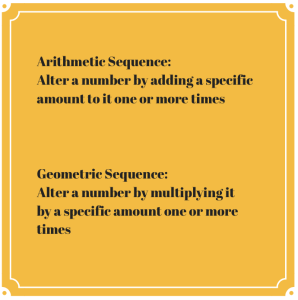
The SAT and ACT love arithmetic and geometric sequences. In this video I’ll show you how they work.

Once you learn how these sequences work, you might want to check out consecutive integer questions, a special type of arithmetic sequence problem.

SAT ACT Prep Arithmetic Geometric Sequences


Want a Free List of All the Math Topics That Have Recently Appeared on the SAT or ACT?

For a free list of all the math topics that have recently appeared on the SAT or ACT, and/or for answers to any other questions, you can reach me at robertkohen@koheneducationalservices.dream.press or 212-658-0834.

How To Get SAT Vocab Questions Right When You Don’t Even Know The Word

As you probably already know, the SAT loves difficult vocabulary. It shows up all over the critical reading section. While you should be studying vocabulary to prepare, you’re probably going to come across at least a word or two on the test you don’t recognize. So what do you do when that happens?

First, don’t panic or automatically jump to the next question. If you stick with the word, there are ways to find out what it means.

You want to first think about any prefixes, roots and suffixes that you can recognize. These are parts of the word that are recognizable because they appear in many words. For example, the word beneficent starts with the prefix “bene,” meaning “good.” Beneficent, sure enough, means “doing good.” This won’t always work (and sometimes these can be misleading), but more often than not they can help. You can find a list of common prefixes, roots and suffixes in nearly all SAT prep books, as well as online.

SATPrepVocab

Once you’ve looked for prefixes/roots/suffixes, your next job is to ask yourself: does this word, or any part of it, look like any other words I know? These can be English or foreign words (as long as the language is relatively close to English, like Spanish, French, German or Latin). If you give yourself a little time, you’ll often be able to connect the word or part of it to another word that you already know. Very often, that can tip you off to the probable meaning of the word, or a meaning close enough to help you answer the question correctly. Check it out:

Dispassionate: See the word passionate in there? Now link that up with the prefix, “dis,” which means “not.” As in “dislike,” or to not like. So what does dispassionate mean? Not passionate or emotional – not influenced by passions or emotions. That simple.

Respite: What other word might you know that this one sounds like? Respiration! “Respite” means a brief break or relief – i.e. like “taking a breather.”

Dominion: How about “dominate”? That’s pretty close, right? Dominion means power or control over a territory – the result of “dominating.”

Derivative: Deriv…derive! A derivative, in fact, is something derived from something else, unsurprisingly enough.

Credence: This one is very close to “credible,” which means believable. Sure enough, credence means believing something to be true.

Avuncular: Pretty uncommon word, no? Can you tease anything out of it? How about uncle? Avuncular means “like an uncle” or “kind like an uncle.” The meaning is hiding right in the middle of the word.

3 Wrong Answer Traps on ACT Reading


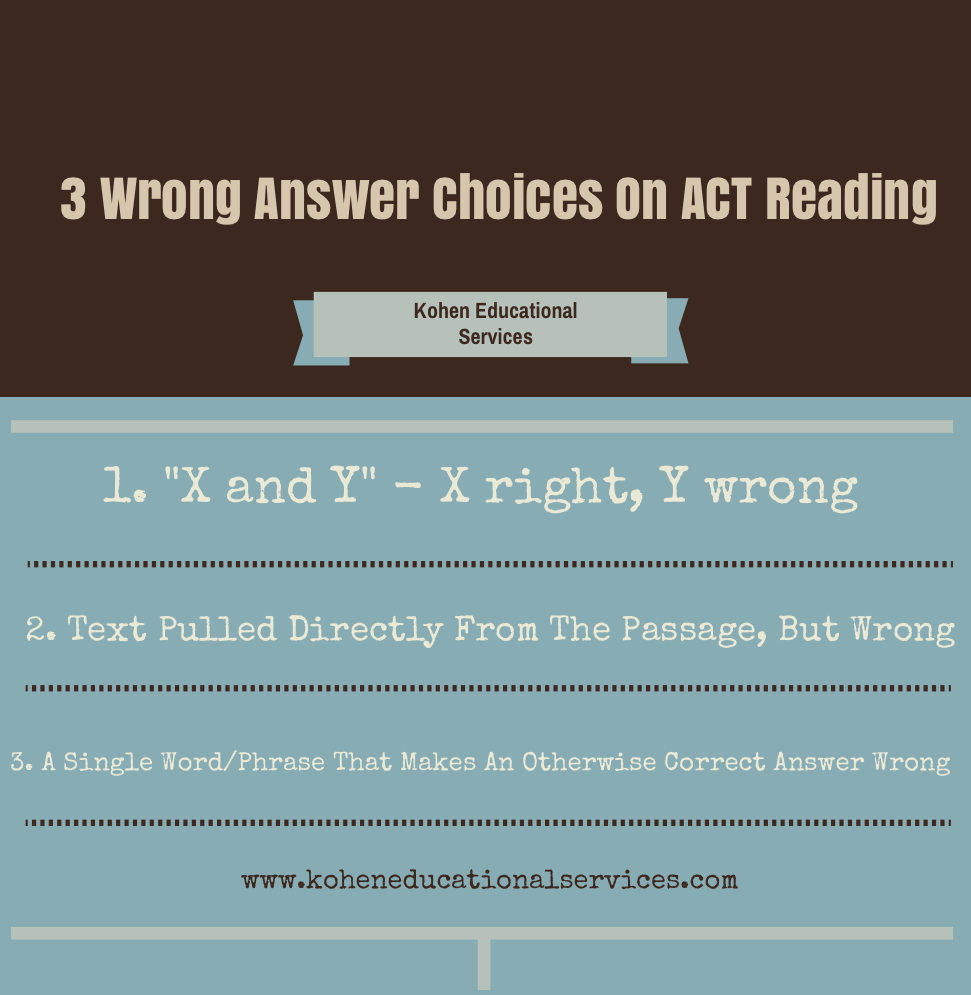
While you won’t be able to predict what passages will appear on ACT Reading come test day, you can know the wrong answer traps that will be waiting for you. The ACT has devised some pretty tricky wrong answer choices. Even the best of critical readers miss ACT reading questions because they are taken off guard by these traps. Fortunately, however, these traps recur over and over. By learning to recognize them now, you can strengthen your performance on test day.

Here are three of the most common wrong answer choices:

1. “X and Y.” This is a classic trap. These test makers provide two separate answers to the question in one answer choice. One of these—usually the first, X—is correct. At this point, many students select this answer choice. The problem, however, is that Y is incorrect. Here’s what one of these looks like:

The volcano erupted because:

A) Pressure built up under the surface (X) and the air was rich with carbon (Y).

Many students choose A because the first part (“pressure built up under the surface”) is correct. A is wrong, however, because the second part (“the air was rich with carbon”) is incorrect.

2. Text pulled directly from the passage. The ACT often places text copied from the passage in a wrong answer choice. Many students fall prey to this trap when they read the answer choice, thinking “I’ve seen this, they do say this in the passage, so this must be right.” Don’t fall for this trap! An answer choice that features text from the passage can be correct, but it’s often incorrect – so be on your guard anytime you see a choice like this. Here’s an example:

What does Sweden fail to recycle?

A)   Oil

“Oil” was mentioned in the passage, so many students will recognize it and mistakenly choose it. In fact, however, oil is mentioned in the passage as something Sweden does recycle.

3. A sleeper phrase in an otherwise correct answer. In this trap, the answer choice will be clearly correct—except for one minor word or phrase, the “sleeper phrase,” that invalidates it. These are some of the trickiest wrong answer choices. Here’s an example:

What does the author want the planes to do?

A)   Fly quickly to Greenland together.

In this instance, the author does want the planes to fly quickly to Greenland—he just never says that they should do so together. “Together” is the sleeper phrase. Here’s another example:

The following is true of a company that takes part in the Recycle-360 Initiative:

A)   It reuses its own waste.

In this instance, the company does reuse waste. The problem is that it reuses the waste of others, rather than its own waste. “Its” is the sleeper phrase.

See how subtle sleeper phrases can be? To get these questions right, you’ll want to make sure to read each answer choice very carefully. If you’re stuck between two choices that both seem correct, look closely at each word (you can even underline them) in the choices. One of them is probably a sleeper phrase.

Screen Shot 2015-04-15 at 10.55.35 AM