Paired passages are a staple of SAT Critical Reading and have recently been introduced on ACT Reading. Although they look intimidating, these passages don’t have to be any more difficult than regular passages.
You can drastically simplify things on paired passages if you work with each passage individually. Read the first passage, then answer all the questions that address that passage alone. These questions will usually be grouped together. Then read the second passage and answer all the questions that address that passage alone. Finally, tackle the questions that ask about both passages.
By breaking the passages and questions into separate groups, you reduce the total amount that you must mentally juggle at any given time. In addition, you’re more likely to answer passage specific questions correctly because the information you need will be more fresh in your mind. This can also save you from burning valuable time since you won’t have to revisit the passage as frequently.
After you finish reading the second passage but before answering the questions for that passage, pause and ask yourself how the two passages relate to one another. If you use annotations, consider jotting this down in a few words. One or more of the questions will ask about how the passages relate, and you’ll be less likely to fall for trap answers if you’ve already articulated the relationship yourself.
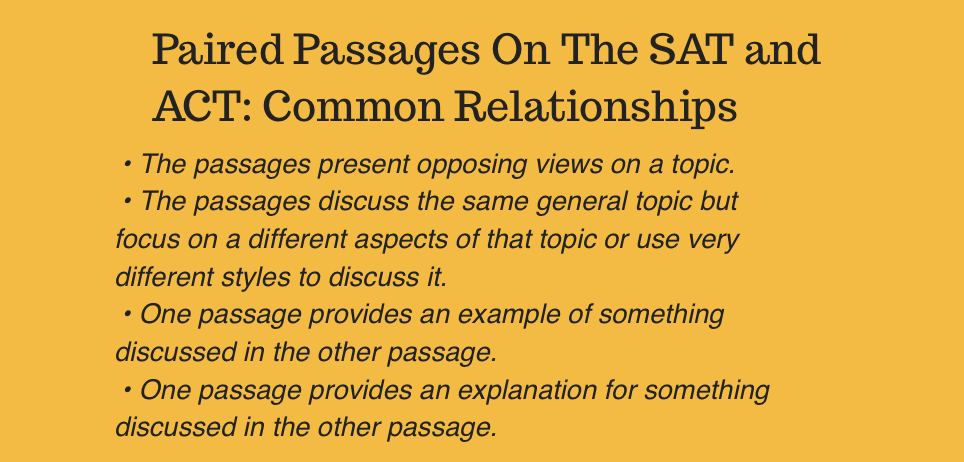
Here are some common relationships to be on the lookout for:
The passages present opposing views on a topic.
The passages discuss the same general topic but focus on a different aspects of that topic or use very different styles to discuss it.
One passage provides an example of something discussed in the other passage.
One passage provides an explanation for something discussed in the other passage.
By looking for these relationships and working with only one passage at a time, you’ll both increase your score and reduce the difficulty level of paired passages.
In order to be successful on SAT and ACT Reading, it’s critical that you read the passages actively. The more actively you read, the better prepared you’ll be for the test questions. You can practice active reading on practice tests and outside reading materials alike.
Active reading is all about asking questions. Throughout the passage, make sure to pause and ask yourself what’s going on. What is being described? What is the main point of the passage? How does everything fit together? Why did the author take the time to write this?
In a non-fiction passage, what’s being described is usually pretty clear. In a scientific or technical passage, however, you may need to spend a little more time than you normally would getting your bearings and making sense of the information provided.
In a fiction passage, what is being described is not always immediately clear. The passage often reveals what’s actually happening only as the story progresses. In that case, make sure to reconsider the first part of the passage in light of the new information that comes later. Can you make sense of the passage’s beginning based on what comes later?
The main point of the passage is the passage’s main idea: pretty much everything in the passage exists to convey this one idea. It’s usually described explicitly in the first or second paragraph and the concluding paragraph (especially in the final sentence or two). You should also look at passage titles and descriptions, because these can also reveal what the passage is primarily about.
How everything fits together is very important. Does the author make a partial shift in topic or opinion halfway through the passage? Why, and what does that change mean? You also want to always ask yourself how any particular part of a passage relates to the whole passage. If you find a paragraph or two especially confusing, try to see how they fit into the passage as whole. This can help you better grasp what’s going on.
The last major question to ask yourself is why the author took the time to write the passage. What are the author’s own thoughts, opinions, and feelings? Is the author passively conveying information, or does s/he feel strongly about that information? Try to pinpoint the author’s exact sentiments.
As you ask yourself these four questions, consider annotating the passage. You can draw line breaks where the passage undergoes major shifts in topic, which will help you keep better track of the argument and know where to look for particular questions. You can also write down the main idea or topic next to a paragraph or group of paragraphs. Just make sure not to annotate so much that it seriously slows you down.
At the level of individual paragraphs, pay special attention to the opening and closing sentences. This is where the main point of the paragraph is usually conveyed. You can then read more quickly through the body of the paragraph, since it usually just provides details to support the main idea. Try not to get too caught up in the details. You don’t need to memorize them, but if you remember the topic of the paragraph, you’ll remember where to find them if you need to for a question.
A final tip to help you read more actively is to get excited about the passage topic. Even if you wouldn’t normally be interested in that topic, try to find some way to connect it to one of your interests. Maybe the passage is about bats, and you have absolutely no interest in bats. Fair enough. But if you were really into Batman as a kid, then think about the passage as background information about Batman.
Pretending that you’re going to be in a debate with the author is also helpful. If you read the passage as if you’re preparing for the debate, you’ll become more passionate about what you’re reading and increasingly engaged. Combine that level of engagement with these strategies and you’ll be in excellent shape on the SAT and ACT reading passages.
Ivy League colleges have become extremely selective. Gone are the days when half of all applicants could gain entrance (wouldn’t it be great if they still did that?!). Now these schools only admit around 10% of applicants: 6% on the low end (Harvard) and 15% on the high end (Cornell).
If you want to submit a competitive application to one of these colleges, you’ll want to make sure your ACT scores fall within that college’s typical range of scores.
Remember, however, that ACT scores aren’t everything in college admissions. While they are very important, they can’t guarantee an automatic acceptance. Grades, extracurriculars, essays, recommendation letters and everything else that you put into your application are also critical to the process.
This list provides the most recent (as of 2015) middle 50% of ACT scores at Ivy League colleges. In other words, the middle 50% of admitted students score within this range, while 25% scored below it and 25% scored above it.
In order to submit a competitive application, aim for the middle of this range or above at your target school. That will ensure that your ACT score is either on par with or greater than the average ACT score at that college.
Every ACT Reading section starts with a prose fiction passage. If you’re like most test takers, you may find this passage more difficult than the others that follow it.
Prose fiction passages don’t typically tell you what they’re about. Instead, they throw you right into the middle of a complex story without providing much contextual background. As if that weren’t bad enough, the questions often send you hunting for mundane details and don’t usually contain helpful line numbers.
All hope is not lost, however. Here are some powerful strategies to help you master this section.
The passage and many of the questions are usually about a relationship between two people. Use this knowledge to your advantage. As you read, ask yourself about the two main characters. What are they like? What do they think or feel? At the same time, ask yourself about their relationship. How are they related? Is their relationship positive, negative or conflicted? If you answer these questions while you’re reading, you’ll be in great shape when it comes to the actual questions.
You must constantly reassess what is happening in the story. Because the prose fiction passage begins in the middle of an ongoing story you know nothing about, it can be very difficult to figure out what exactly is happening. The more you read, however, the more will be revealed and the clearer things will become. Use any new contextual information to make sense of what’s happened so far. In other words, occasionally pause throughout the passage to regroup and make sense of the plot.
Give yourself more time. With its obtuse plot and very specific questions, the prose fiction passage usually takes more time to complete than the other passages. A good way to split up your time is to spend 11 minutes on the prose fiction passage and 8 minutes on each of the three following passages.
Map the passage. This is to help you answer those questions that ask for very specific details. Without a good map of the passage, these details can be nearly impossible to find. Note when the passage shifts topics in a major way and consider drawing line breaks to mark these shifts. You can also make short annotations to note what each section is about or any significant points in that passage. If you can divide the passage up into a few major sections, it will be easier to know where to look when a question asks about a specific detail.
Note any mention of time when reading the passage. Prose fiction passages often include a question about when something happened. Whenever time is mentioned, make a special note of it. It’s likely there’ll be a question about it.
If a major crisis occurs during your SAT, don’t worry. Unlike the ACT, the SAT allows you to cancel your scores before they are ever processed. In order to do so, however, you must act quickly.
You can ask the test supervisor at the testing center to cancel your score immediately after you’ve taken the exam, or you can fax a written request to College Board by 11:59PM on the Wednesday after you took the test. If you go the latter route, make sure to call College Board before the deadline to make sure the fax has been received.
As easy as all this sounds, it’s generally not a good idea to cancel your score. If you cancel your score, you’ll never know how well you did—which is probably better than you think. Students often feel like they’ve performed poorly on the test, only to find out when the score arrives three weeks later that they’ve done well. Accurately gauging your performance is impossible without the official score report.
Even if you do receive a low score, the vast majority of colleges will ignore it if you score higher on another test. Most schools either “superscore” the SAT—cherry pick your highest individual section scores from across test dates—or they take your highest composite score. At many of these schools, admissions officers will never even see the lower scores, because computer software only selects your highest scores to be included in your admissions file.
When should you cancel your score then? If there was a major crisis during the test. Perhaps you had to leave midway through the exam because of a medical emergency, or your calculator died and your backup batteries didn’t work. Even though most schools won’t consider your lowest score, there’s no reason to add it to your testing record.
If, on the other hand, you only think that you performed poorly on the test, avoid cancelling your score. You may be pleasantly surprised when your score finally arrives.