Should You Send Those Four Free SAT Score Reports?


Anytime you register for the SAT you automatically receive four free score reports. This means that the College Board will send your scores to any four universities you choose, free of charge. All you have to do is request the reports anytime up to 10 days after taking the test.

That sounds like an enticing offer, especially since regular score reports cost a whopping $11.25 each, with rush orders running as high as $31.

There’s a catch, however: you’ll have to send your scores before you know what they are.

sat four free score reports

The College Board doesn’t release your results until about three weeks after the test, or in other words until 11 days after you must decide whether or not to send the free reports. If you choose to send the reports, then, you risk sending low scores if you end up having bombed the test.

So should you send the reports? The answer depends. First, some background:

Most colleges will only consider your highest SAT score, either by “superscoring” (cherry picking your highest section scores from across test dates) or by taking your highest composite score. In fact, many of these schools use software that automatically selects your highest scores for your application file, so admissions officers won’t even see your lowest scores.

A much smaller number of colleges consider all your SAT scores together. These schools require that you send all of your SAT scores.

Only send the free score reports to colleges that require all your SAT scores. If you’re not applying to any of these schools, don’t use the free reports.

Because you’ll have to send your scores to schools that require all scores eventually, you might as well do so now for free.

For schools that don’t require all scores, why risk sending low scores to the admissions committee if you don’t have to? Even though they promise to only consider your highest score, and even though some of them won’t even see your lowest scores, some might. Could this negatively influence an admissions officer? Possibly – so why risk it?

You’ll also save money by reserving the free reports for schools requiring all scores, since you may be able to cut down on the total number of reports you send by doing so.

How do you know which schools require all your SAT scores? You can find the complete list on College Board’s website here. Make sure to check with any particular schools you’re interested in for their most current policies, however, as requirements change often.

SAT and ACT Math: Finding Terms In An Arithmetic Sequence When Given The Sum Of The Sequence

Learn a rapid method for solving this popular SAT and ACT problem type that asks you to identify a term in an arithmetic sequence based on the sum of the sequence. If you’re not familiar with arithmetic sequences, first check out this video.

The SAT and ACT will also ask you to do the opposite of this process, i.e. to take the sum of an arithmetic sequence, as in a sum of consecutive integers problem.

sat_act_math_finding_terms_of_arithmetic_sequence_when_given_sum

Want a Free List of All the Math Topics That Have Recently Appeared on the SAT or ACT?

For a free list of all the math topics that have recently appeared on the SAT or ACT, and/or for answers to any other questions, you can reach me at robertkohen@koheneducationalservices.dream.press or 212-658-0834.

Paired Passages Made Easy On SAT Critical Reading and ACT Reading


Paired passages are a staple of SAT Critical Reading and have recently been introduced on ACT Reading. Although they look intimidating, these passages don’t have to be any more difficult than regular passages.

You can drastically simplify things on paired passages if you work with each passage individually. Read the first passage, then answer all the questions that address that passage alone. These questions will usually be grouped together. Then read the second passage and answer all the questions that address that passage alone. Finally, tackle the questions that ask about both passages.

By breaking the passages and questions into separate groups, you reduce the total amount that you must mentally juggle at any given time. In addition, you’re more likely to answer passage specific questions correctly because the information you need will be more fresh in your mind. This can also save you from burning valuable time since you won’t have to revisit the passage as frequently.

SAT Critical Reading ACT Reading Paired Passages


After you finish reading the second passage but before answering the questions for that passage, pause and ask yourself how the two passages relate to one another. If you use annotations, consider jotting this down in a few words. One or more of the questions will ask about how the passages relate, and you’ll be less likely to fall for trap answers if you’ve already articulated the relationship yourself.

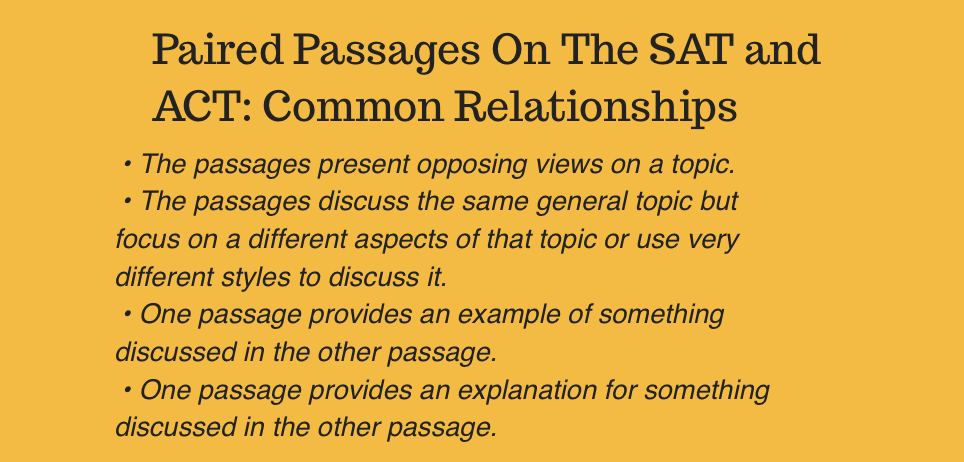
Here are some common relationships to be on the lookout for:

  • The passages present opposing views on a topic.
  • The passages discuss the same general topic but focus on a different aspects of that topic or use very different styles to discuss it.
  • One passage provides an example of something discussed in the other passage.
  • One passage provides an explanation for something discussed in the other passage.

By looking for these relationships and working with only one passage at a time, you’ll both increase your score and reduce the difficulty level of paired passages.


How To Read Passages On SAT Critical Reading and ACT Reading


In order to be successful on SAT and ACT Reading, it’s critical that you read the passages actively. The more actively you read, the better prepared you’ll be for the test questions. You can practice active reading on practice tests and outside reading materials alike.

Active reading is all about asking questions. Throughout the passage, make sure to pause and ask yourself what’s going on. What is being described? What is the main point of the passage? How does everything fit together? Why did the author take the time to write this?

sat_act_critical_reading_how_to_read

In a non-fiction passage, what’s being described is usually pretty clear. In a scientific or technical passage, however, you may need to spend a little more time than you normally would getting your bearings and making sense of the information provided.

In a fiction passage, what is being described is not always immediately clear. The passage often reveals what’s actually happening only as the story progresses. In that case, make sure to reconsider the first part of the passage in light of the new information that comes later. Can you make sense of the passage’s beginning based on what comes later?

The main point of the passage is the passage’s main idea: pretty much everything in the passage exists to convey this one idea. It’s usually described explicitly in the first or second paragraph and the concluding paragraph (especially in the final sentence or two). You should also look at passage titles and descriptions, because these can also reveal what the passage is primarily about.

How everything fits together is very important. Does the author make a partial shift in topic or opinion halfway through the passage? Why, and what does that change mean? You also want to always ask yourself how any particular part of a passage relates to the whole passage. If you find a paragraph or two especially confusing, try to see how they fit into the passage as whole. This can help you better grasp what’s going on.

The last major question to ask yourself is why the author took the time to write the passage. What are the author’s own thoughts, opinions, and feelings? Is the author passively conveying information, or does s/he feel strongly about that information? Try to pinpoint the author’s exact sentiments.

As you ask yourself these four questions, consider annotating the passage. You can draw line breaks where the passage undergoes major shifts in topic, which will help you keep better track of the argument and know where to look for particular questions. You can also write down the main idea or topic next to a paragraph or group of paragraphs. Just make sure not to annotate so much that it seriously slows you down.

At the level of individual paragraphs, pay special attention to the opening and closing sentences. This is where the main point of the paragraph is usually conveyed. You can then read more quickly through the body of the paragraph, since it usually just provides details to support the main idea. Try not to get too caught up in the details. You don’t need to memorize them, but if you remember the topic of the paragraph, you’ll remember where to find them if you need to for a question.

A final tip to help you read more actively is to get excited about the passage topic. Even if you wouldn’t normally be interested in that topic, try to find some way to connect it to one of your interests. Maybe the passage is about bats, and you have absolutely no interest in bats. Fair enough. But if you were really into Batman as a kid, then think about the passage as background information about Batman.

Pretending that you’re going to be in a debate with the author is also helpful. If you read the passage as if you’re preparing for the debate, you’ll become more passionate about what you’re reading and increasingly engaged. Combine that level of engagement with these strategies and you’ll be in excellent shape on the SAT and ACT reading passages.


What ACT Score Do I Need To Get Into An Ivy League College?

Ivy League colleges have become extremely selective. Gone are the days when half of all applicants could gain entrance (wouldn’t it be great if they still did that?!). Now these schools only admit around 10% of applicants: 6% on the low end (Harvard) and 15% on the high end (Cornell).

act_scores_for_ivy_league_colleges

If you want to submit a competitive application to one of these colleges, you’ll want to make sure your ACT scores fall within that college’s typical range of scores.

Remember, however, that ACT scores aren’t everything in college admissions. While they are very important, they can’t guarantee an automatic acceptance. Grades, extracurriculars, essays, recommendation letters and everything else that you put into your application are also critical to the process.

This list provides the most recent (as of 2015) middle 50% of ACT scores at Ivy League colleges. In other words, the middle 50% of admitted students score within this range, while 25% scored below it and 25% scored above it.

In order to submit a competitive application, aim for the middle of this range or above at your target school. That will ensure that your ACT score is either on par with or greater than the average ACT score at that college.

Brown                        30 – 34  Target: 32

Columbia                   32 – 35  Target: 34

Cornell                       30 – 34  Target: 32

Dartmouth                 30 – 34  Target: 32

Harvard                     32 – 35  Target: 34

Princeton                   31 – 35  Target: 33

U Penn                      31 – 34  Target: 33

Yale                           32 – 35  Target: 34