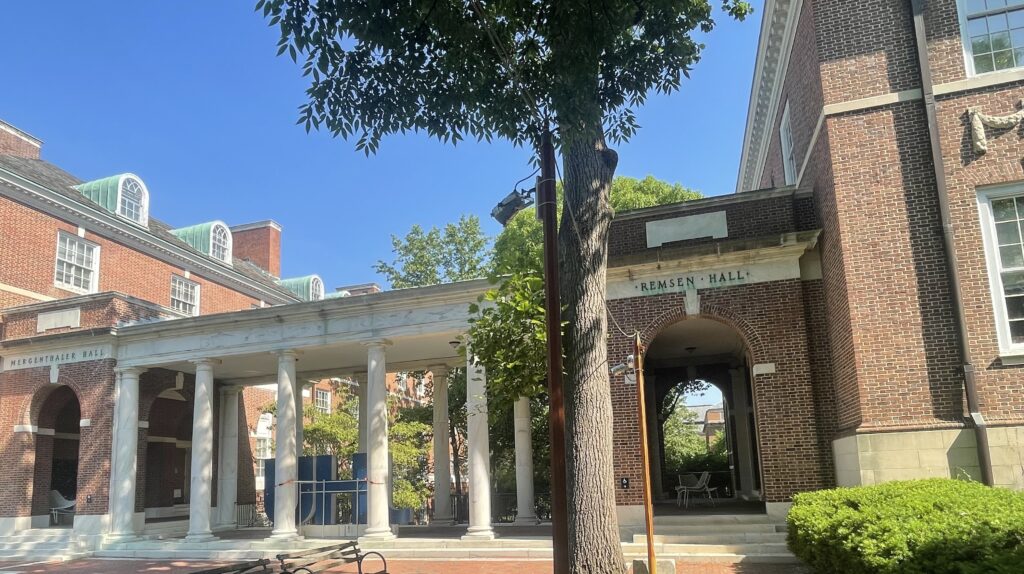
I recently visited Johns Hopkins University in Baltimore, where I toured campus and spoke with the admissions office about the latest trends in admissions. Here are some takeaways from my visit:
· Hopkins is a mid-sized, private university with a beautiful self-contained campus in Baltimore’s Homeland neighborhood. With its rigorous academics and ambitious, driven students, Hopkins offers a demanding environment layered with extensive support, from bountiful tutoring and student success coaching to its Well-Being Lab.
· Given Hopkins’ outstanding medical school, it comes as no surprise that premed is huge here. Research opportunities are extensive, along with connections to area hospitals, like Mercy Hospital, where students volunteer. While the medical school is located in a different part of town, undergraduates frequently take advantage of the regular shuttle that runs there to get involved in medical research. Note that popular health-related clubs can be competitive, however: the campus EMT program, for instance, has around a 10% admit rate.
· Students live on campus their first two years and then typically move into off-campus housing around the college. Most don’t have cars, as it is fairly easy to get around Baltimore using campus shuttles and public buses. DC is only a 45-minute train ride away.
· While most known for its STEM-leaning student body, Hopkins places a large emphasis on interdisciplinary learning. It also houses strong departments in the humanities and social sciences: international studies is one of the largest programs on campus (there is also a new campus center in DC), and the creative writing program is the second-oldest in the United States. Five-year dual degrees in music and fine arts are offered through Peabody, the university’s conservatory.
· Hopkins’ curriculum emphasizes the real-world application of one’s studies, and its action-oriented students look to use their learning to make a positive impact. The career center–the Life Design Lab–begins advising students freshman year to help prepare them for a flexible, design-oriented approach to work.
· There are multiple robust, tight-knit cultural student organizations on campus, from the Black Student Union to Hillel and a wide variety of Latino student groups.